Magpie-Lark
The Fascinating Australian Bird With a Distinctive Voice
If you’ve ever heard a cheerful series of musical calls coming from a backyard tree, there’s a good chance a magpie-lark was nearby. This familiar Australian bird is easy to recognise once you know what to look for. Its striking black-and-white feathers, upright stance and lively personality make it a favourite among backyard birdwatchers.
Despite its name, the magpie-lark isn’t actually a magpie or a lark. It belongs to a separate bird family and has its own distinctive habits, calls and behaviours. You might know it by its other common name, the peewee, which comes from the sound of its familiar two-note call.
Spend a little time watching one and you’ll soon discover there’s much more to this small bird than its attractive appearance.
What Is a Magpie-Lark?
The magpie-lark (Grallina cyanoleuca) is a medium-sized Australian bird found across much of mainland Australia and parts of southern New Guinea. It is a common sight in gardens, parks, open woodland, farmland and suburban neighbourhoods.
Although it shares some colouring with the Australian magpie, the two birds are not closely related. The magpie-lark belongs to the family Monarchidae, which includes monarch flycatchers and related birds.
Adult magpie-larks generally measure around 25–30 centimetres in length. They have relatively long legs, a straight posture and a sturdy body, making them quite noticeable when standing on an open lawn.
Their black-and-white colouring is their most recognisable feature. However, there’s an interesting difference between males and females.
How to Identify a Magpie-Lark
The magpie-lark is one of those birds you can learn to recognise quite quickly. Its contrasting plumage makes identification fairly straightforward, particularly when you get a good look at the head and face.
Male Magpie-Lark
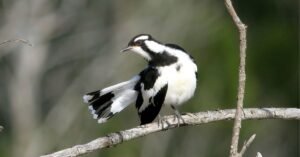
The adult male has a black throat, white eyebrow and white cheek markings. His head and upper body are mostly black, while his underside is white.
The combination of black and white gives him a distinctive appearance, especially when he’s perched on a fence, roofline or low tree branch.
Female Magpie-Lark
The female looks similar but has an important identifying difference. Her throat is white rather than black, and her facial markings are arranged differently.
Once you know this feature, telling the sexes apart becomes much easier.
Young Magpie-Larks
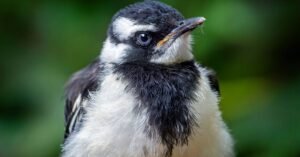
Young birds have less clearly defined markings and can appear greyer or browner than adults. Their plumage gradually develops the familiar black-and-white pattern as they mature.
If you see a family group in your garden, look carefully at their markings. You may be watching adult birds with their recently fledged young.
Where Do Magpie-Larks Live?
Magpie-larks are widely distributed throughout Australia. They occur in many different environments, from coastal suburbs and inland towns to open farmland and woodland areas.
They are particularly comfortable around people and frequently visit suburban gardens where there is open ground and a reliable supply of insects.
Unlike some birds that prefer dense vegetation, magpie-larks often choose relatively open areas. You may see them walking across lawns, school ovals, sporting fields, roadside grass or freshly watered gardens.
They need access to food, suitable nesting locations and water. Trees, shrubs, buildings and fence posts all provide useful perching and nesting opportunities.
Magpie-larks are generally resident birds, although local movements can occur when conditions change or food becomes less available.
What Do Magpie-Larks Eat?
Magpie-larks are primarily insect eaters. They spend much of their time searching for small invertebrates on the ground, where their long legs help them walk around while looking for food.
Their diet includes:
- Ants and termites.
- Beetles and beetle larvae.
- Spiders.
- Caterpillars.
- Flies and other small insects.
- Other small invertebrates.
You may notice a magpie-lark following a lawnmower or exploring recently disturbed soil. This is no coincidence.
When the ground is turned over, insects and larvae can become easier to find. A freshly mown lawn can also expose small creatures that would otherwise remain hidden in longer grass.
How Do They Find Their Food?
Magpie-larks usually forage by walking across open ground and picking up suitable prey from the surface or just below it.
They are particularly active around damp soil, garden beds and lawns after rain, when small invertebrates may be easier to locate.
If you want to encourage these birds into your garden, maintaining some natural ground cover and avoiding unnecessary insecticide use can help support their food supply.
The Remarkable Calls of the Magpie-Lark
One of the most enjoyable things about having magpie-larks nearby is listening to their calls.
Their familiar pee-wee sound is often heard in the morning and throughout the day. It is a clear, musical call that carries surprisingly well across open spaces.
Magpie-larks are also well known for their duetting behaviour. A male and female may call back and forth in a coordinated fashion, sometimes sounding as though they are having a conversation.
These vocal exchanges are an important part of their social and territorial behaviour.
Why Do Magpie-Larks Call So Much?
Calling helps magpie-larks communicate with their partners and defend their territory. Their voices can warn neighbouring birds to keep their distance while also helping a pair maintain contact.
If you hear two birds calling together from a nearby tree, take a moment to watch them. You may notice one bird responding almost immediately after the other.
It’s a lovely example of natural bird communication.
Magpie-Lark Nesting Habits
Perhaps one of the most interesting things about magpie-larks is their nesting behaviour.
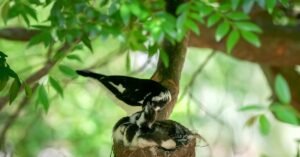
They construct distinctive bowl-shaped nests using mud, grass and other plant material. These nests are often built on horizontal branches, tree forks, buildings or other suitable structures.
Both parents participate in nest construction, making the process a shared undertaking.
The finished nest is usually quite substantial compared with the bird’s size. Its mud walls provide a firm structure, while softer materials help create a suitable nesting surface.
When Do Magpie-Larks Breed?
Breeding can occur at different times of the year, depending on local conditions. Rainfall, food availability and temperature can all influence breeding activity.
A typical clutch contains three to five eggs, which are incubated by both parents. Both adults also help feed and care for the young.
Once the chicks hatch, their parents work hard to bring back a steady supply of insects. This period can be particularly demanding for the adult birds.
If you discover an active nest near your home, observe it from a respectful distance. Avoid disturbing the adults or approaching the nest unnecessarily.
Magpie-Lark Behaviour and Territorial Habits
Magpie-larks are generally confident birds. They often spend time in pairs and can become quite protective of the areas where they feed and breed.
You may see them chasing other birds away from their nesting site or calling loudly when another bird enters their territory.
They are also known for their characteristic upright stance. When standing on the ground, they often pause between steps, looking around before continuing their search for food.
This stop-start movement makes them interesting to watch.
Why Do Magpie-Larks Attack Windows and Car Mirrors?
During breeding season, some magpie-larks become particularly territorial. They may see their reflection in a window, glass door or car mirror and mistake it for another bird.
The bird may then repeatedly approach, peck or flutter against the reflective surface.
This behaviour can be frustrating for homeowners, but the bird is responding to what it believes is a territorial challenge.
Reducing reflections by temporarily covering the affected section of glass or using an appropriate external window treatment can help. Avoid harming or attempting to catch the bird.
How to Attract Magpie-Larks to Your Garden
If you’re a bird lover, having magpie-larks visit your backyard can be a real pleasure. They are particularly attracted to gardens that provide natural food and accessible open spaces.
You don’t need an elaborate bird-friendly garden to make your property more appealing.
Try these simple ideas:
- Maintain some open lawn: Magpie-larks like searching for insects on open ground.
- Avoid excessive pesticides: Chemicals can reduce the insects they depend on for food.
- Provide a shallow birdbath: Fresh, clean water gives visiting birds somewhere to drink and bathe.
- Keep suitable trees and shrubs: These provide perching and potential nesting locations.
- Leave some natural garden areas: A mixture of vegetation and open ground supports a wider range of insects.
Remember that feeding wild birds isn’t necessary. Providing a suitable natural environment is usually the better approach.
Interesting Facts About the Magpie-Lark
Here are some fascinating facts worth knowing about this familiar Australian bird.
- It isn’t a true magpie: Despite its common name, the magpie-lark belongs to a different bird family.
- It is also called a peewee: The name comes from its distinctive two-note call.
- Males and females look different: The throat markings are one of the easiest ways to distinguish them.
- Both parents build the nest: Nest construction is a shared activity.
- It makes mud nests: These sturdy structures are often built on branches or buildings.
- It eats mainly insects: Ants, beetles, spiders and other small invertebrates make up much of its diet.
- It is comfortable around people: Magpie-larks regularly visit suburban gardens, parks and sporting grounds.
Frequently Asked Questions About Magpie-Larks
Are magpie-larks native to Australia?
Yes. Magpie-larks are native to Australia and are widespread across much of mainland Australia. They are also found in parts of southern New Guinea.
What is the difference between a male and female magpie-lark?
The easiest difference to spot is the throat colour. Adult males have a black throat, while adult females have a white throat.
What does a magpie-lark eat?
Magpie-larks mainly eat insects and other small invertebrates, including ants, beetles, spiders and caterpillars. They commonly search for food on lawns and open ground.
Why are magpie-larks called peewees?
The nickname comes from their distinctive two-note call, which sounds like the words pee-wee.
Do magpie-larks mate for life?
Magpie-larks are generally socially monogamous and often maintain long-term pair bonds. Their partnerships are supported by shared nesting, territorial defence and parental care.
Where do magpie-larks build their nests?
They build bowl-shaped nests from mud, grass and plant material. Nests are commonly placed in tree forks, on horizontal branches and sometimes on buildings or other suitable structures.
Are magpie-larks aggressive?
They can be territorial, especially during breeding season. They may chase other birds away from their nesting area and sometimes attack their reflections in windows or car mirrors.
Enjoy Watching Magpie-Larks in Your Backyard
The magpie-lark is a wonderful example of Australia’s familiar backyard wildlife. Its bold black-and-white plumage, cheerful calls and fascinating mud-building skills make it a bird worth getting to know.
Next time you see one walking across your lawn, take a closer look. Notice how it searches for insects, how it carries itself and whether another bird is nearby.
You might even hear a pair calling to each other from opposite sides of the garden.
For bird lovers, these everyday encounters are part of the pleasure of watching Australian wildlife. Sometimes, the most interesting birds are the ones already living right outside your window.